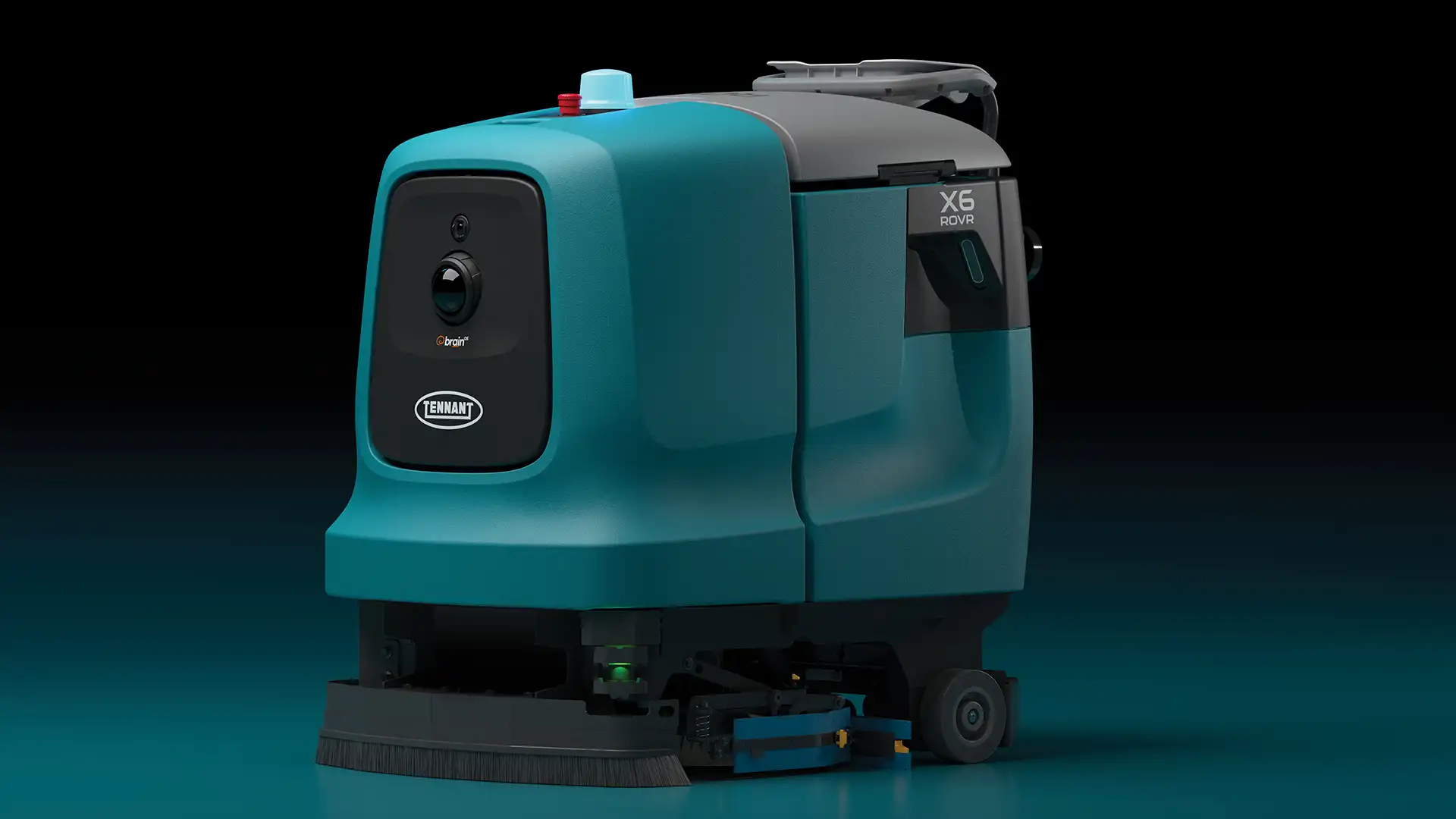
The Tennant X6 ROVR is a commercial and industrial cleaning robot. It is optimised for cleaning dynamic spaces through manoeuvrable design and sophisticated navigation software. The X6 ROVR addresses the problem of customer labor shortages and provides a solution that greatly reduces cleaning effort while improving quality, productivity, and consistency.
Operators can easily program the machine to clean automatically or perform spot cleaning in manual mode. The primary autonomous mode allows building managers to do more cleaning with less labor, while allowing workers to focus on high-value tasks that otherwise may go undone. The progressive, yet powerful design integrates and protects the many sensors and cameras that work together to inform the intelligence required to safely guide the machine.
Customer ROI is enhanced with an available charging dock that ensures the machine is always charged and ready for work and that no job goes half done.
Robots are complex technology-laden devices. However, the cleaning operator is often a low-skill labourer with little training or experience. Therefore, to deliver value for the customer, the X6 ROVR must provide autonomous performance that can be mapped and initiated by the average cleaner.
Autonomous operations are programmed by simply guiding the machine over the desired route while a map is recorded for playback – teach & repeat. To make this step easy, the X6 ROVR includes intuitive propel assistance that requires no extra knobs or switches to learn and actuate.
The efficient footprint of the machine combined with a folding handle that stows for autonomous use allows the machine to fit through standard doorways while the 26” cleaning path provides impressive productivity in large spaces. The outstanding manoeuvrability along with sophisticated 3D lidar navigation nearly eliminates the need for human “assists” due to its ability to detect and evade people and dynamic aisle way obstacles.
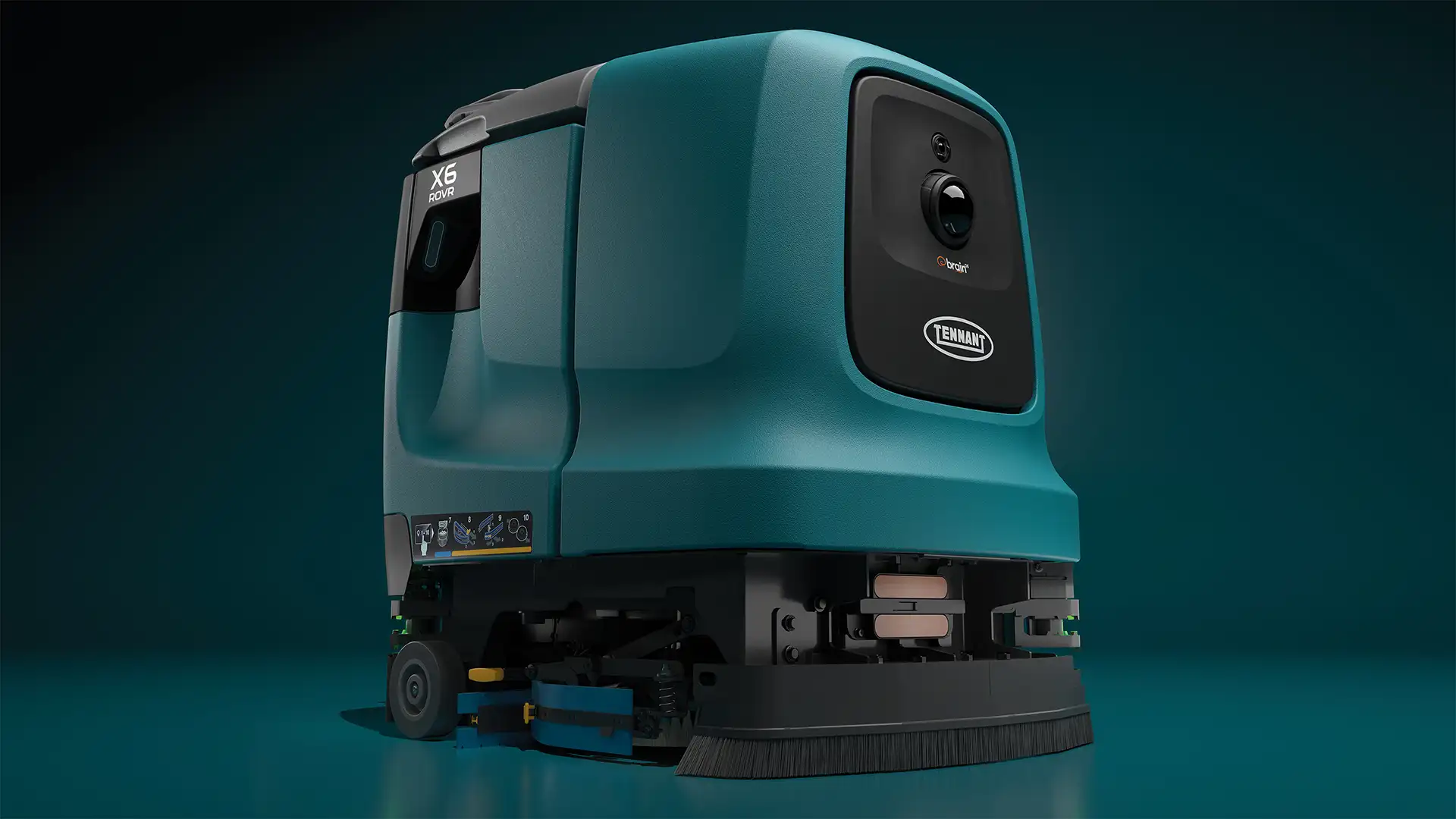
Customer research indicates that when maintenance is hard to do, it doesn’t get done. A machine that isn’t properly maintained loses performance and is less reliable. Therefore, the machine highlights easy-to-access regular service items with colour-coded instructional graphics to guide users through both yellow “Daily”, and blue “Weekly +” maintenance activities. Better than a misplaced manual, these helpful labels prevent costly machine downtime while improving machine performance and customer satisfaction.
For the user, the X6 ROVR helps get the hard, dirty work of cleaning done by tackling the floors and freeing up workers for more valuable and enjoyable tasks. Cleaners can feel that they now have an “employee” reporting to them. They are elevated to a robotic technician as compared to a low-level worker pushing a mop or trudging behind a manual floor scrubber. When the time comes to maintain their new co-worker, the integrated maintenance graphics act as a step-by-step guide linked to on-screen videos to help guide them.
For the cleaning managers, a robot never complains, calls in sick, or fails to show up for work. Additionally, the X6 ROVR is very consistent. The completed cleaning path is recorded and can be displayed to site supervisors as confirmation that their spaces were cleaned. Therefore, manager anxiety is reduced, and contracts are retained.
In designing a robotic machine there are many sensors & cameras to package in precise locations to provide the visibility which makes autonomous use possible. In addition, these sensors are expensive components that must be protected from damage and allowed to dissipate heat. While considering these objectives, it is important that the overall design embrace Tennant’s visual brand language that represents power and progress.
Progress is implied through simple and soft shapes. The goal is to make the product look friendly and approachable, yet sophisticated and “techy”. A flowing river is the metaphor used to describe the concave channel that runs down the side and transitions to a convex surface as it moves to the front and frames the prominent black bezel containing the 3D camera and lidar. Top surfaces are generously crowned and devoid of extra detail. Touch points such as the operator handle, and user maintenance points are designed to be ergonomic and intuitive.
Power is represented with durable roto molded tanks and shrouds and the use of exposed steel in areas where strength and rugged protection are important for long-term durability and customer satisfaction.
Colour application: Yellow and blue touch points are utilised at key maintenance interface points to aid in training and ease-of-use. Black is used to convey technology as it frames and conceals the many sensors and cameras throughout the machine. It is also used to convey toughness and durability in the lower steel components.
Category:IndustrialAward Year:2025Designers:John Ickes, Grant Leacox, Andy Verhasselt, Tou Yia Thao, Tennant Company R&D, Tennant Company, Eden Prairie, Minnesota, USAManufacturer:Tennant Company, Eden Prairie, Minnesota, USA